Nevada repair shops charge a median $138 an hour for labor. California shops aren't far behind at $135. Run that rate through a ten-minute cabin air filter swap, and the labor line can cost more than the filter, which barely changes in price from one state line to the next.
That labor charge is the hidden part of the cabin air filter replacement cost. Most drivers never notice it, because it sits inside a single total at the bottom of the invoice. I broke it out using the newest state labor data so you can hold any quote up against what shops in your area charge and decide whether a ten-minute job is worth paying for.
TL;DR Quick Answers
cabin air filter replacement cost
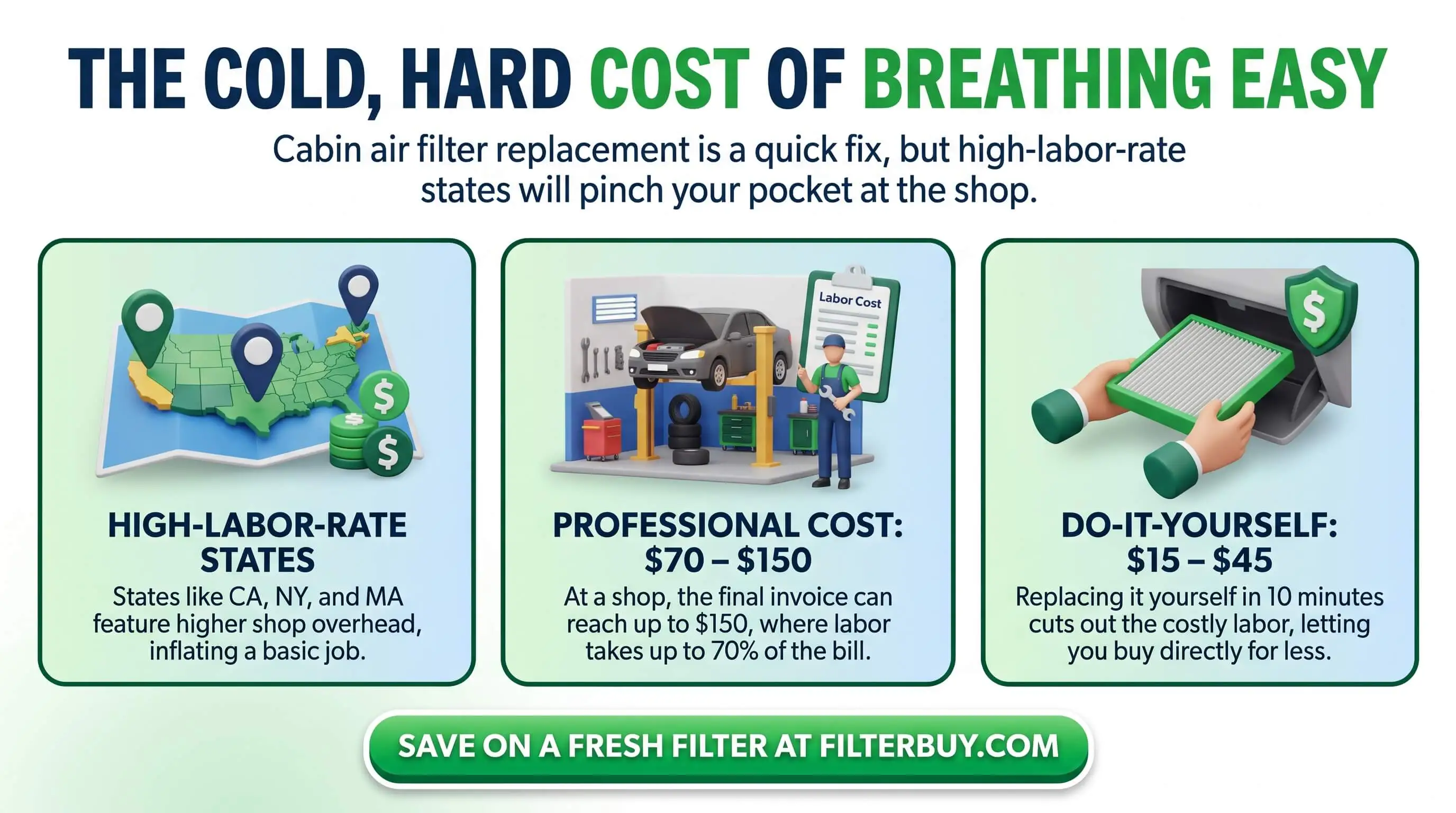
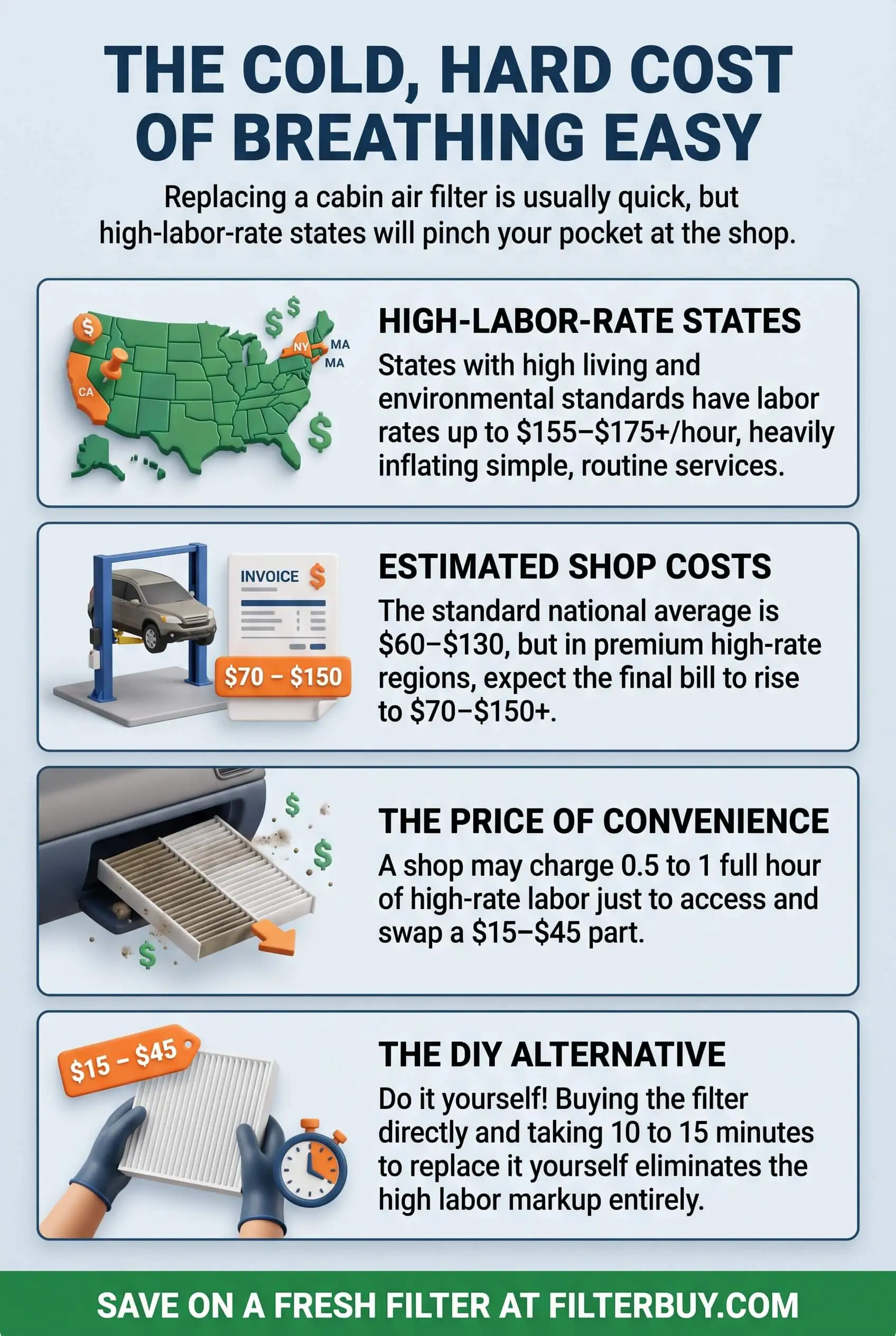
Cabin air filter replacement cost runs about $60 to $130 at a repair shop and $15 to $50 if you swap it yourself. The filter barely changes in price from state to state. Labor does, and it makes up roughly half the shop bill, so your ZIP code decides most of what you pay.
Do it yourself: $15 to $50 for the filter alone. Most glove-box filters take about ten minutes and no tools.
Independent shop: About $60 to $130. Shops usually bill labor from a flat-rate guide, not the clock.
High-labor-rate states: Nevada leads at a $138 hourly median, with California and Hawaii near $135. A big-metro quote there lands around $70 to $120.
Quote check: Filter price + (billed hours × local hourly rate) shows whether a quote is fair.
How often: Every 12,000 to 15,000 miles, or about once a year.
Top Takeaways
The part costs about the same everywhere. Labor drives the state-to-state gap in cabin air filter replacement cost.
Nevada, California, and Hawaii lead. Their median shop rates run about $135 to $138 an hour, against a $120 national median.
Your metro matters as much as your state. Los Angeles shops post a $150 median, while small-town shops sit near $100.
The formula settles it. Filter price plus billed hours times your local rate shows whether a quote is fair.
Doing it yourself erases the premium. A glove-box filter takes about ten minutes and costs you nothing in labor.
What Sets the Price of a Cabin Air Filter Replacement
Two lines make up the bill: the part and the labor. The part is a cabin air filter, also called a pollen filter. It's a pleated panel in your car's outside-air intake that traps dust, pollen, and smoke before they reach your vents, and it usually runs $15 to $50 wherever you live.
Labor is where your ZIP code shows up.
Why a 10-Minute Job Can Bill Like a Half Hour
On most cars, the filter sits behind the glove box, and a technician can swap it in about ten minutes. Shops rarely bill the clock, though. Many price labor from a flat-rate guide that assigns a set time to each job, and many add a minimum billing increment on top. Your shop multiplies its hourly rate by that fixed block no matter how fast the work goes. When the rate climbs, so does your bill. Similar labor pricing considerations can apply to home HVAC services, including maintenance and repairs for heat pumps.
Which States Have the Highest Auto Repair Labor Rates
Invoice data from 2,411 U.S. repair shops, collected from November 2025 through October 2026, puts the national median at $120 an hour. These states sit above it:
Nevada: $138 median
California: $135 median
Hawaii: about $135 median
Alaska: about $130 median
New Jersey, New York, Oregon, and Kansas: $125 median
And the numbers keep moving. Over the past year, 41% of those shops raised their hourly rate, most by about $20. Other surveys order the states a little differently, so read this list as a current snapshot.
Why Shops Charge More There
A shop's labor rate has to cover technician pay, rent, insurance, and diagnostic equipment, and all of it costs more in high-cost states. Some states also hold shops to stricter rules. California requires repair shops to register with its Bureau of Automotive Repair and to hand you a written estimate before any work starts. Those rules work in your favor. Running a shop in a high-rent, closely regulated market also costs more, and the posted rate reflects it.
Your ZIP Code Matters as Much as Your State
The same data shows a $120 median at big-metro shops and $100 at small-town and rural ones. Los Angeles tops the major metros at $150 an hour. Denver follows at $135. Live in a lower-rate area but work downtown? The shop near your office may charge more than the one near your house.
What the Same Job Costs in a Big City vs. a Small Town
Here's the formula I use to check any quote: filter price + (billed labor time × local hourly rate). Most shops bill between 0.3 and 0.5 hours for a glove-box filter.
Los Angeles metro at $150 an hour: Labor runs $45 to $75. Add a $25 to $45 filter, and your total lands around $70 to $120.
Small-town shop at $100 an hour: Labor runs $30 to $50, for a total around $55 to $95.
That $15 to $25 difference comes back every time the filter is due, which for most drivers means once a year. Dealerships usually post higher rates than independent shops and often install original-equipment filters. In a high-rate metro, expect a dealer quote at or above the top of that range.
How to Pay Less When Your State Charges More
A few minutes of your own time pays off here.
Find your filter first. Your owner's manual shows where it sits. Behind the glove box usually means no tools and about ten minutes of work.
Swap it yourself when it's easy to reach. You'll pay for the filter and skip the labor line entirely, and labor is the part your state inflates.
Bring your own filter to the shop. If you'd rather not do it yourself, ask whether the shop will install one you supply. Many will, and you'll avoid the parts markup.
Add it to a visit you've already booked. Pair the swap with an oil change or scheduled service so it rides along on a trip you're already paying for.
Get the estimate in writing. Ask the shop to list parts, labor, and billed hours separately. California, New York, and Washington all give you written-estimate rights under set conditions.
Pick a filter grade that fits how you drive. Some cabin filters list efficiency ratings much like the MERV ratings used for home filters. If you sit in heavy traffic or commute through smoke season, carbon media earns its price. While MERV 11 pleated furnace air filters help capture airborne particles in your home, carbon cabin air filters can also help reduce certain odors and gases inside your vehicle.
When Paying a Shop Still Makes Sense
Not every car makes this easy. Some hide the filter under the dash, beneath the cowl at the base of the windshield, or behind a trim panel. If yours does, the shop visit is money well spent. Old plastic clips snap without much warning, and replacing them can cost more than the labor you meant to save. Unlike major HVAC repairs such as ductwork replacement, a cabin air filter change is usually a smaller job, but difficult access can still make professional help worthwhile.
"Every cabin filter I've written up on a service order got its labor time from the flat-rate guide, not the clock. The tech might be done in eight minutes, but guide time multiplied by our posted rate is what prints. In a high-rate market, the install can end up costing more than the filter."
7 Essential Resources
Cabin air filter replacement cost breakdown: National price ranges by vehicle, plus a parts-versus-labor split you can hold your local quote against.
FTC: Auto Repair Basics: Covers what a written estimate should include and how flat-rate pricing differs from billing for actual time.
California Bureau of Automotive Repair: A Consumer's Guide to Auto Repair: Explains your right to a written estimate, your approval before extra charges, and an itemized invoice in one of the highest-rate states.
New York DMV: Know Your Rights in Auto Repair: Estimates have to show labor charges and how the shop calculated them, and a shop can't go over the estimate without your OK.
Washington Attorney General: Auto Repair: Shows when you're owed a written estimate and how the 10% cap limits charges you didn't approve.
Legal Aid Center of Southern Nevada: Car Repairs: Walks through estimates, itemized charges, and getting your old parts back in the state with the highest median labor rate.
EPA: Reduce Your Smoke Exposure: Recommends closed windows and recirculate mode to keep wildfire smoke out of your car, one more reason to keep the cabin filter fresh.
3 Statistics
$50,620. Median annual pay for automotive service technicians and mechanics in May 2025, or $24.34 an hour. The rest of a $120-plus shop rate pays for rent, tools, insurance, and training. (Bureau of Labor Statistics)
4.9%. The jump in motor vehicle maintenance and repair prices from January 2025 to January 2026. No other transportation item added more to inflation. (Bureau of Transportation Statistics)
60.4 minutes. The average time U.S. drivers spent behind the wheel each day in 2024. Your cabin filter cleans the air you breathe for every one of those minutes. (AAA Foundation for Traffic Safety)
With vehicle repair costs rising 4.9% and Americans spending an average of 60.4 minutes driving each day, choosing high quality filters and comparing replacement costs can help drivers maintain cleaner cabin air without overspending on maintenance.
Final Thoughts
I don't think high labor rates are the villain here. Shops in expensive markets carry heavy costs, and the consumer laws in California and New York make their pricing easier to read than most. What bothers me is paying a premium hourly rate for a job that, on most cars, doesn't need a single tool.
If your filter sits behind the glove box, swap it yourself and save the shop's time for work that needs a lift and a trained technician. If it's tucked somewhere harder to reach, get the billed hours in writing and compare two quotes. Either way, you're the one keeping the air clean for everyone who rides with you. Just as a pleated furnace filter helps capture airborne particles in your home, a clean cabin air filter helps protect the air inside your vehicle.
Frequently Asked Questions
Which State Has the Most Expensive Auto Repair Labor?
Nevada, with a $138 median per hour in the latest invoice data. California and Hawaii follow at about $135. Big metros run higher still, and Los Angeles shops sit near $150.
Is It Cheaper to Replace a Cabin Air Filter Yourself?
Yes. You pay only for the filter, usually $15 to $50, and skip a labor charge that can hit $45 to $75 in high-rate metros. Most glove-box filters take about ten minutes and no tools.
Why Does a Dealership Charge More for a Cabin Air Filter?
Dealers usually post higher hourly rates than independent shops, bill from flat-rate guides, and install original-equipment filters. The work itself doesn't change.
Can a Shop Charge More Than My Written Estimate?
In many states, not without your OK. California makes a shop get your permission before it goes over the estimate. New York bars charges above the estimate unless you consent, and Washington caps unapproved overages at 10%.
How Often Should I Replace My Cabin Air Filter?
Most automakers recommend every 12,000 to 15,000 miles, or about once a year. Your owner's manual has the exact interval. Change it sooner if you drive through dust, wildfire smoke, or heavy pollen.
Know What Cabin Air Filter Replacement Should Cost Where You Live
Open your owner's manual to find where your filter sits, then price the part on its own before you call a shop. Compare the best air filters for your vehicle to find one that fits your needs and budget. With the formula and a written estimate in hand, you'll know whether the local quote is fair or whether a ten-minute swap at home is the better deal.


