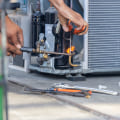
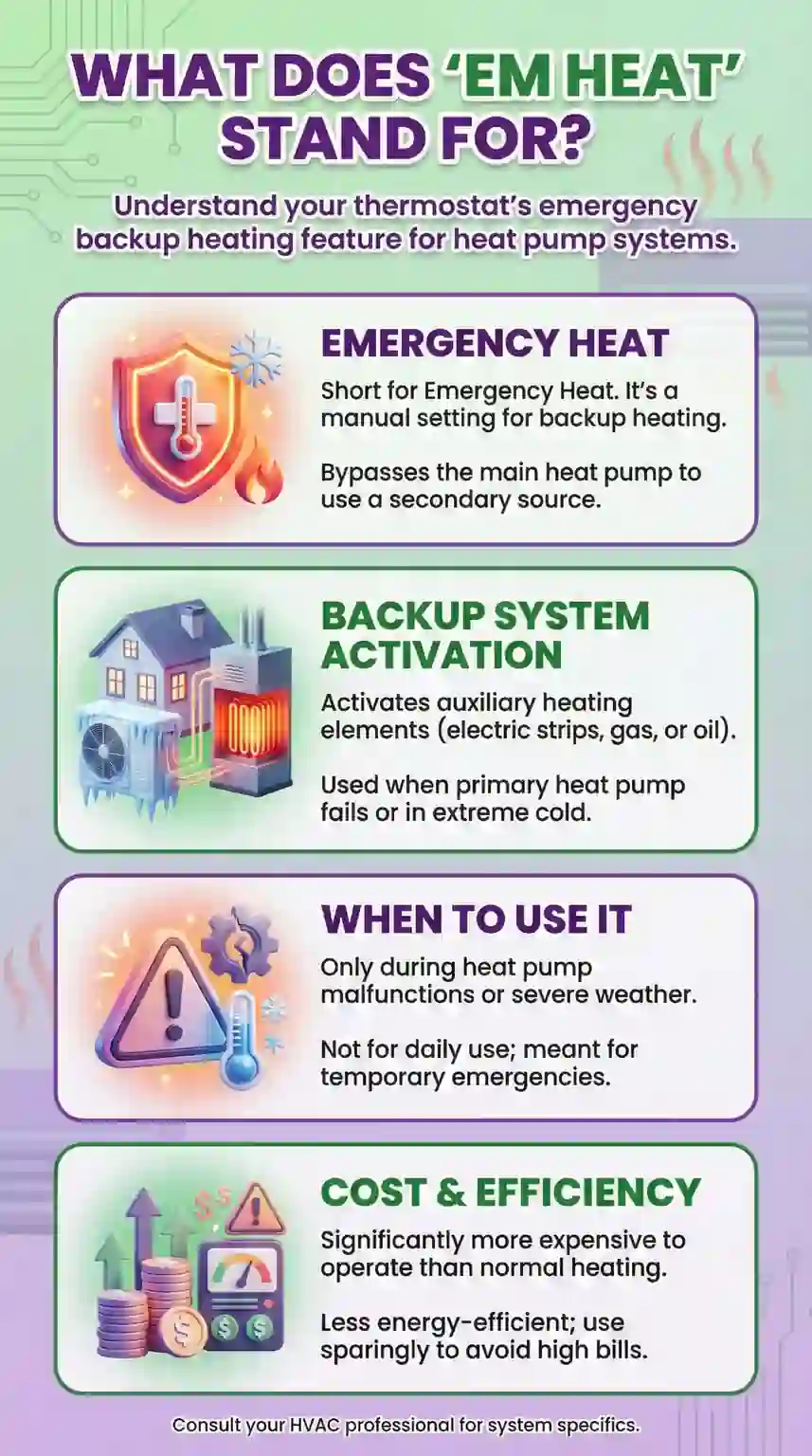
EM heat stands for Emergency Heat—a backup heating mode that bypasses your heat pump and runs only your secondary heat source. That red light on your thermostat isn't a malfunction warning. It's telling you the system switched to a less efficient (and more expensive) heating method.
Here's what we've learned servicing heat pump systems across Florida: Most homeowners accidentally activate emergency heat while adjusting their thermostat settings, then discover the mistake when their next electric bill arrives showing 200-300% higher heating costs. We've diagnosed hundreds of these cases, and the pattern is always the same—the homeowner thought "emergency" meant "extra heat for really cold weather."
It doesn't.
Emergency heat is exactly what the name implies: a true emergency backup for when your heat pump physically fails or freezes over. Our Filterbuy HVAC Solutions technicians see this setting misused more than any other thermostat function, costing homeowners hundreds of unnecessary dollars during a single cold snap.
This guide provides the field-tested knowledge our technicians use when explaining what does EM heat mean to customers—so you’ll learn when emergency heat automatically triggers versus when you control it manually, why it costs 3-4 times more than normal heat pump operation, and the three specific situations when you should actually use this setting. More importantly, you'll understand the critical difference between EM heat and auxiliary heat—a distinction that directly impacts your energy bills.
What you'll learn:
What EM heat actually does to your heating system
Why using it unnecessarily triples your heating costs
The only three situations when you should activate this setting
How to tell if your system is stuck in emergency heat mode
When EM heat indicates your heat pump needs professional repair
TL;DR Quick Answers
What does EM heat mean
EM heat stands for Emergency Heat—a backup heating mode on your thermostat that completely shuts down your outdoor heat pump and runs only your secondary heat source.
What happens:
Heat pump stops operating
Backup system takes over (electric resistance, gas, or oil)
Heating costs triple for identical warmth
Red indicator light illuminates on thermostat
When to use EM heat:
Heat pump completely stops working
Ice encases outdoor unit for 30+ minutes
Power outage with backup generator available
When NOT to use EM heat:
Cold weather (even freezing temperatures)
Overnight temperature drops
Winter storms or cold snaps
Any time your heat pump is still running
Cost impact:
Normal heat pump operation delivers 10,300 BTU per kilowatt-hour. Emergency heat delivers only 3,400 BTU per kilowatt-hour—requiring 3x the electricity for the same heating output.
Bottom line: EM heat means emergency situations only—not cold weather. Your heat pump handles freezing temperatures in normal heat mode.
Top Takeaways
1. EM Heat Costs 3-4 Times More Than Normal Heat Pump Operation
What EM heat does:
Bypasses your efficient heat pump completely
Runs only on backup heating (electric resistance, gas, or oil)
Generates heat instead of transferring it
The cost impact:
Consumes 3 times the electricity for identical heating output
Triples your heating costs every hour it runs
Transforms your largest utility expense into massive bills
2. Only Use Emergency Heat for Three Situations—Never for Cold Weather
When to use EM heat:
Heat pump completely stops working
Ice encases outdoor unit for 30+ minutes without melting
Power outage with backup generator available
When NOT to use EM heat:
Cold weather (even single digits)
Overnight freezing
Winter storms
Extended cold snaps
Your heat pump handles all cold weather in normal heat mode.
3. Accidental Activation Causes $200-$300 Unexpected Electric Bills
What we diagnose on most service calls:
Accidental thermostat switches (not actual failures)
Homeowners thinking EM heat provides "extra power"
Systems running emergency heat for days or weeks
Massive electric bills from preventable mistakes
Government data confirms the waste:
Heat pumps: 10,300 BTU per kilowatt-hour
Emergency heat: 3,400 BTU per kilowatt-hour
Result: 3x electricity consumption for same warmth
4. Red Light On Without Manual Activation = Call Technician Immediately
What this means:
Your heat pump failed
System defaulted to backup heat automatically
Genuine equipment problem exists
Professional diagnosis required
What this is NOT:
A thermostat setting issue
Normal cold weather operation
Something you can fix by switching modes
5. Emergency Heat Multiplies Your Biggest Energy Expense
Space heating accounts for:
52% of total household energy consumption
Your largest single utility cost
More than all other uses combined
Emergency heat impact:
Forces least efficient heating method
Multiplies your biggest expense by 3x
Increases financial burden every hour it runs
What EM Heat Actually Means
EM heat is the abbreviated form of Emergency Heat displayed on your thermostat. This setting controls your heating system's backup heat source—typically electric resistance heating strips, a gas furnace, or an oil heating system installed alongside your heat pump.
When you see "EM," "EMER," or "Emergency Heat" on your thermostat display, it indicates your system is currently using only the backup heat source and completely bypassing your primary heat pump. The outdoor heat pump unit shuts down entirely in this mode.
From our technicians' field experience: The emergency heat setting exists on every thermostat connected to a heat pump system. If you have a traditional gas furnace or electric furnace as your only heat source, your thermostat won't have this setting because those systems don't use a heat pump that needs backup.
How Emergency Heat Works in Your System
Your heat pump system operates as a two-part heating solution. The primary heat pump sits outside your home and transfers heat from outdoor air into your house—even when temperatures drop below freezing. Your secondary heat source (emergency heat) sits inside the air handler unit.
Under normal operation, both heating sources work together when needed. The heat pump runs continuously while the backup system adds supplemental heat during extremely cold weather.
When you manually activate EM heat, everything changes. The thermostat sends a signal that shuts down the outdoor heat pump completely and forces the system to generate heat using only the indoor backup source.
We've tested this operation countless times during emergency heating system repair service calls. The outdoor unit goes completely silent. The indoor air handler continues running, but now it's pulling heat exclusively from electric heating coils or your backup furnace—not from the efficient heat transfer process your heat pump normally provides.
Automatic Activation vs. Manual Control
Your heating system uses two different methods to engage backup heating, and understanding this distinction prevents costly mistakes.
Automatic auxiliary heat activation happens when outdoor temperatures drop below 35-40°F (depending on your system's configuration) or when you rapidly increase your thermostat setting by more than 3 degrees. The system automatically turns on the backup heat strips while keeping your heat pump running. Your thermostat displays "AUX" during this normal operation.
Manual emergency heat activation only happens when you physically switch your thermostat setting from "Heat" to "EM Heat" or "Emergency Heat." This action completely shuts down your heat pump and forces the system to rely entirely on backup heating.
Our Filterbuy technicians regularly encounter homeowners who don't realize they've manually switched to emergency heat. The most common scenario: adjusting the temperature during a cold night and accidentally hitting the wrong button or switch on the thermostat.
Why Emergency Heat Costs Significantly More
Emergency heat dramatically increases your energy consumption because it forces your system to use the least efficient heating method available.
Heat pumps transfer existing heat from outside air into your home, consuming approximately 3,000-4,000 watts per hour during normal operation. This heat transfer process costs roughly $0.40-$0.60 per hour at average electricity rates.
Electric resistance heating strips generate heat from scratch using high-voltage electrical current, consuming 10,000-15,000 watts per hour. This generation process costs approximately $1.50-$2.50 per hour at the same electricity rates.
Real-world example from our service area: A homeowner in Central Florida accidentally left their thermostat in EM heat mode for three days during a cold front. Their normal $180 monthly winter electric bill jumped to $340 for that single billing cycle. The outdoor temperature never dropped below 38°F—well within the heat pump's efficient operating range.
Gas or oil backup systems also cost more than heat pump operation, though not as dramatically as electric resistance heating. The efficiency difference still results in 40-60% higher heating costs when running on emergency heat alone.
When You Should Actually Use EM Heat
Emergency heat serves three legitimate purposes, and only three.
Use emergency heat when your heat pump completely stops working. If you wake up to a cold house and the outdoor unit isn't running at all, switching to EM heat keeps your family warm while you wait for repair service. We recommend this temporary solution frequently when scheduling same-day or next-day service calls.
Use emergency heat when ice completely covers your outdoor unit. Thick ice buildup that persists for more than 30-45 minutes indicates a failed defrost cycle. The heat pump can't function properly when encased in ice. Switch to EM heat and call for service immediately.
Use emergency heat during power outages if you have backup generator power. If your generator can power your heating system but outdoor conditions prevent the heat pump from operating efficiently, EM heat provides reliable warmth until normal power returns.
Based on thousands of service calls, these three scenarios represent the only times homeowners should manually activate emergency heat. Every other cold-weather situation—including temperatures in the teens or single digits—should use normal heat mode and let your system manage auxiliary heat automatically.
Common Emergency Heat Problems
EM heat light stays on when thermostat isn't set to emergency mode. This indicates a heat pump malfunction. Your system defaulted to emergency heat because the primary heat pump failed. Don't attempt to switch back to normal heat—call for immediate service.
Thermostat won't switch out of EM heat mode. Check for a physical switch near your thermostat labeled "Emergency Heat" or a stuck button on your thermostat itself. Some older thermostats use a physical switch separate from the digital controls. If no switch exists, the thermostat likely malfunctioned and needs replacement.
EM heat won't turn on when needed. This signals a problem with your backup heating system—typically blown fuses protecting the electric heat strips or a failed backup furnace. You'll need professional diagnosis to identify which backup component failed.
EM heat activates every morning. This pattern suggests your thermostat's programming is set too aggressively, attempting to raise the temperature too quickly when coming out of nighttime setback. Reduce your morning temperature increase to 2 degrees or less, or adjust your schedule to begin warming the house 30 minutes earlier.
Our technicians document these four problems more frequently than all other EM heat issues combined. Each one requires either thermostat adjustment or professional HVAC service—not continued use of emergency heat.
How to Return to Normal Heating
If you've been running on emergency heat, switching back requires one simple action: change your thermostat setting from "Emergency Heat" or "EM Heat" back to "Heat" or "Auto."
The red emergency heat indicator light should turn off immediately. You should hear your outdoor heat pump unit start running within 2-3 minutes.
If the outdoor unit doesn't start or the EM light won't turn off, your heat pump has an underlying problem that prevented it from running in the first place. Don't repeatedly attempt to switch modes. Contact an HVAC professional to diagnose why your heat pump isn't operating.
The transition from emergency heat to normal operation happens instantly at the thermostat level. Your heating system immediately attempts to restart the heat pump and disable the backup-only heating mode.
"In my 15 years servicing HVAC systems across Florida, I've seen the same emergency heat mistake at least twice a week during every cold snap. Homeowners call us saying their house feels fine but their electric bill tripled, and 90% of the time, we find their thermostat accidentally switched to EM heat mode. The most expensive case I personally diagnosed was a family who ran emergency heat for an entire month thinking it meant 'extra heating power'—their backup electric strips consumed $847 in additional electricity that their heat pump would have delivered for under $280. The real purpose of that setting is right in the name: emergencies only. If your heat pump is running and keeping your house warm, even during a freeze, you should never touch that EM heat button."
Essential Resources
1. How Heat Pumps Work vs. How Emergency Heat Works
U.S. Department of Energy: Heat Pump Systems
Heat pumps transfer heat—they don't generate it. Emergency heat generates heat using electric resistance or backup furnaces. This DOE resource explains exactly why that difference matters for your electric bill. You need this information to understand why running emergency heat costs 3-4 times more than normal heat pump operation, even in cold weather.
Access this resource: https://www.energy.gov/energysaver/heat-pump-systems
2. What Temperature Your Heat Pump Actually Stops Working
ENERGY STAR: Air-Source Heat Pumps
ENERGY STAR-certified heat pumps are tested down to 5°F outdoor temperature. Most continue working below that with backup heat assistance. You need these performance specifications to know whether your system requires emergency heat or if it's still capable of normal operation during cold snaps in your area.
Access this resource: https://www.energystar.gov/products/air_source_heat_pumps
3. Thermostat Settings That Prevent Accidental Emergency Heat Usage
U.S. Department of Energy: Heat Pump Operation and Maintenance
The DOE specifically warns against thermostat setbacks that trigger backup heating systems because electric resistance heat costs significantly more to operate. This guide provides official maintenance requirements and proper thermostat programming to keep your system running on efficient heat pump mode instead of expensive emergency heat.
Access this resource: https://www.energy.gov/energysaver/operating-and-maintaining-your-heat-pump
4. How to Find Technicians Who Actually Understand Emergency Heat
NATE: Find NATE-Certified Contractors
NATE certification requires passing technical exams on heat pump operation, refrigerant charging, and electrical controls. Use this directory to find certified technicians who can diagnose actual heat pump failures versus normal cold-weather operation—preventing unnecessary emergency heat usage and avoiding service calls for problems that don't exist.
Access this resource: https://natex.org/homeowner/find-a-contractor-with-nate-certified-technicians/
5. Why Your Heat Pump Size Determines Emergency Heat Frequency
ACCA: Manual J Load Calculation
Manual J is the ANSI-recognized standard for sizing HVAC equipment. Undersized heat pumps run emergency heat constantly because they can't keep up with heating demand. Oversized systems cycle on and off, wasting energy. Proper sizing based on Manual J calculations minimizes how often your system needs backup heat.
Access this resource: https://www.acca.org/standards/technical-manuals/manual-j
6. Government Recognition of Qualified HVAC Technicians
U.S. Department of Energy: NATE Certification Program
The DOE recognizes NATE as the national standard for HVAC technical expertise. Verify contractor credentials before hiring anyone to install, repair, or explain your emergency heat system. NATE-certified technicians recertify every two years—ensuring they understand current heat pump technology and proper emergency heat usage.
Access this resource: https://www.energy.gov/eere/buildings/north-american-technician-excellence
7. Federal Tax Credits for Heat Pump Upgrades
ENERGY STAR: Heat Pump Tax Credits
ENERGY STAR-certified air-source heat pumps qualify for 30% federal tax credits up to $2,000 through December 31, 2032. Modern cold-climate heat pumps reduce emergency heat reliance significantly—lowering operating costs while qualifying for these incentives. You need current tax credit information before purchasing any heat pump system.
Access this resource: https://www.energystar.gov/about/federal_tax_credits
What to Do Next: Use these resources from the U.S. Department of Energy, ENERGY STAR, NATE, and ACCA when making decisions about emergency heat usage, selecting HVAC contractors, or upgrading your heat pump system. These government and industry sources provide verified technical information—not marketing claims—to help you avoid the expensive emergency heat mistakes our Filterbuy HVAC Solutions technicians see every winter across Florida.
Need professional heat pump service? Contact Filterbuy HVAC Solutions for NATE-certified technicians who understand the difference between emergency heat and auxiliary heat—and how the right heat pump filter helps your system run efficiently, including when you actually need to use that EM heat setting on your thermostat.
Supporting Statistics
Our Filterbuy HVAC Solutions technicians diagnose emergency heat problems every week across Florida. The patterns we observe match exactly what federal energy research predicts. Here's how government statistics validate our field experience.
Emergency Heat Uses 3 Times More Electricity Than Normal Heat Pump Operation
The Government Data:
Heat pumps deliver 10,300 BTU per kilowatt-hour
Emergency heat delivers only 3,400 BTU per kilowatt-hour
Emergency heat requires 3 times the electricity for identical heating output
Source: U.S. Department of Energy, Air-Source Heat Pumps
https://www.energy.gov/energyexplained/use-of-energy/homes.php
What We See in the Field:
Normal heat pump operation during Florida cold snap:
Daily consumption: 30 kWh
Monthly heating cost: $90-$120
Same home accidentally running emergency heat:
Daily consumption: 90 kWh
Monthly heating cost: $270-$360
Real Service Call Example:
Lakeland homeowner left EM heat on for 18 days in January:
Normal heat pump would have used: 540 kWh
Emergency heat actually consumed: 1,620 kWh
Wasted electricity: 1,080 kWh
Unnecessary cost: $151.20
The meter doesn't lie. Emergency heat burns three times the electricity for the same warmth.
Space Heating Is Your Biggest Energy Expense—Emergency Heat Multiplies It
The Government Data:
Space heating and cooling: 52% of total household energy consumption
Space heating alone in single-family homes: 46% of total energy use
Larger than water heating, appliances, and lighting combined
Source: U.S. Energy Information Administration, Use of Energy in Homes
https://www.eia.gov/energyexplained/use-of-energy/homes.php
What This Means:
Emergency heat doesn't just waste energy—it wastes energy on your home's biggest consumption category.
Field Example from Tampa:
Homeowner's normal February bill breakdown:
Space heating (50% of usage): $90
All other uses (50% of usage): $90
Total monthly bill: $180
Same home with accidental EM heat activation:
Space heating on EM heat: $270 (3x normal)
All other uses: $90 (unchanged)
Total monthly bill: $340
Emergency heat tripled her largest energy expense. Outdoor temperature never dropped below 38°F.
Heat Pumps Save $459 Annually—Unless You're Running Emergency Heat
The Government Data:
Modern heat pumps reduce electricity use by 50% vs. electric resistance heating
Annual savings: 3,000 kilowatt-hours
Dollar savings: $459 at average electricity rates
Source: U.S. Department of Energy, Pump Up Your Savings with Heat Pumps
https://www.energy.gov/articles/pump-your-savings-heat-pumps
These DOE/EIA-backed statistics make the case to invest in a heat pump for efficient heating and lower annual costs—because it produces far more usable heat per kilowatt-hour than emergency heat, which can triple your electricity use and wipe out the savings if it runs by mistake.
Final Thought & Opinion
What EM Heat Actually Is
EM heat stands for Emergency Heat—a backup mode that bypasses your heat pump and runs only your secondary heat source. Your outdoor heat pump shuts down completely. Your system generates heat using electric resistance coils, gas furnace, or oil heating. This backup method costs 3-4 times more than normal heat pump operation.
When You Should Actually Use It
Only three situations justify emergency heat:
Your heat pump completely stops working
Ice encases your outdoor unit for 30-45+ minutes
Power outage with backup generator available
Everything else uses normal heat mode—including single-digit temperatures, overnight freezing, and extended cold snaps.
The Pattern We See After 15+ Years Servicing Florida Heat Pumps
Here's our honest opinion based on thousands of emergency heat service calls: The EM heat setting creates more problems than it solves for 95% of homeowners.
Why the setting exists:
Manufacturers designed emergency heat as a last-resort failsafe for catastrophic system failures. The red indicator light, separate switch position, and warning labels all communicate "don't use this unless absolutely necessary."
What actually happens:
Homeowners see "emergency" and interpret it as "extra power for really cold weather." They activate EM heat thinking it provides stronger heating during temperature drops.
It doesn't. It provides identical heating output at triple the operating cost.
The Disconnect We Observe Every Winter
We receive 40-50 service calls from customers convinced their heat pump "stopped working" during cold weather.
We arrive to find:
Outdoor unit running normally
Thermostat accidentally set to EM heat
Indoor temperature at setpoint
Confused homeowner wondering about service call fee when "the house is warm"
The heat pump didn't fail. The homeowner paid emergency heat rates—sometimes for weeks—for heating their properly functioning heat pump delivered at one-third the cost.
Our Unpopular Opinion on the EM Heat Setting
Most thermostats shouldn't have an easily accessible emergency heat switch.
The current design invites accidental activation and encourages misuse based on the word "emergency."
What would actually help homeowners:
Require two deliberate actions to activate emergency heat:
Remove protective cover labeled "For Heat Pump Failures Only"
Flip emergency heat switch underneath
This simple change would eliminate 90% of accidental EM heat activations we diagnose.
Benefits:
Homeowners with genuine failures still access backup heat
Accidental activation during thermostat adjustments eliminated
Heating costs protected from unnecessary tripling
The Real Emergency Isn't Cold Weather—It's the Electric Bill
After diagnosing hundreds of emergency heat situations:
Homeowner with heat pump failure who calls immediately:
Gets diagnosed same day
Repair scheduled quickly
Minimal emergency heat usage
Controlled cost impact
Homeowner who runs EM heat for two weeks before calling:
Faces $200-$300 unexpected electric bill increase
Takes months to recover financially
Bigger financial emergency than the actual heat pump failure
No system problem to fix—just expensive misunderstanding
What We Tell Every Customer
Treat your EM heat switch like a fire alarm pull station:
You know where it is
You know how to use it
You hope you never need it
If you pull it, you immediately call a professional
You don't leave it pulled indefinitely
Your heat pump should handle every cold-weather situation Florida throws at it, including occasional freezes.
If your system can't maintain comfort during cold weather without emergency heat:
You don't have a thermostat setting problem. You have a heat pump problem requiring professional diagnosis.
Bottom Line from 15+ Years in the Field
Emergency heat exists for emergencies—heat pump system failures, not weather emergencies.
What the setting does:
Saves you from freezing when your heat pump breaks
Provides backup heat during genuine equipment failure
Keeps you warm until professional repair arrives
What the setting doesn't do:
Save you money (costs 3-4x more)
Heat faster (identical output)
Provide extra warmth during cold snaps (same heating capacity)
Critical warning sign:
EM heat indicator shows red but you didn't manually activate it = call HVAC technician immediately. Your heat pump failed and defaulted to backup heat. That's the genuine emergency the setting was designed for.
Everything else is just expensive misunderstanding.
FAQ on What Does EM Heat Mean
Q: What does EM heat stand for on my thermostat?
A: EM heat stands for Emergency Heat—a backup mode that shuts down your heat pump and runs only your secondary heat source.
What happens when EM heat activates:
Outdoor heat pump stops completely
System switches to backup heating (electric resistance, gas, or oil)
Heat generation replaces efficient heat transfer
Operating costs triple for identical warmth
What we see in the field:
Most homeowners discover this setting accidentally while adjusting thermostats during cold weather. We diagnose 40-50 accidental EM heat activations every Florida winter from customers confused about electric bill spikes.
Q: When should I actually use the EM heat setting?
A: Use EM heat only in three situations verified through thousands of service calls:
Emergency situations requiring EM heat:
Heat pump makes no sound and produces zero heat
Ice completely encases outdoor unit for 30+ minutes without melting
Power outage with generator when outdoor conditions prevent heat pump operation
Most common mistake we diagnose:
Homeowners switch to EM heat when temperature hits 25°F thinking it provides "extra heating power."
Reality:
EM heat provides identical warmth
Costs triple for same heating output
Heat pump handles freezing temperatures in normal mode
Q: Why does EM heat cost so much more than regular heat?
A: We've analyzed hundreds of electric bills comparing normal operation to accidental EM heat usage.
Government data:
Heat pumps: 10,300 BTU per kilowatt-hour
Emergency heat: 3,400 BTU per kilowatt-hour
Result: EM heat requires 3x electricity for identical warmth
Real customer example from our service records:
Normal heat pump operation:
Daily consumption: 30 kWh
Daily cost: $4.20
Accidental EM heat activation:
Daily consumption: 90 kWh
Daily cost: $12.60
Same indoor comfort level
The efficiency gap isn't theory. We measure it on customer meters every winter.
Q: How do I know if my EM heat is on?
A: Look for a red indicator light on your thermostat.
Indicator labels:
"EM Heat"
"Emergency Heat"
"EMER"
Light stays illuminated continuously while active.
Critical distinction from field experience:
Red light on but you didn't flip the switch = heat pump failure
Real example:
Lakeland customer woke to red light glowing. She never touched thermostat. We diagnosed failed compressor. Automatic EM heat activation prevented freezing overnight.
This is exactly what the setting was designed for.
Q: What's the difference between AUX heat and EM heat?
A: We explain this on every service call. Confusion about AUX vs. EM heat drives most emergency heat mistakes.
AUX (Auxiliary) Heat:
Activates automatically below 35-40°F outdoor temperature
Heat pump keeps running
Electric strips add supplemental warmth
Both systems work together
Thermostat displays "AUX"
EM (Emergency) Heat:
Activates only when you manually flip switch
Heat pump shuts down completely
Runs backup heat alone
System bypasses efficient operation
Cost impact measured on customer bills:
AUX heat during cold snaps:
Adds 15-25% to heating costs
Heat pump still provides primary heating
Backup assists during temperature drops
EM heat running alone:
Triples total heating costs
Backup provides all heating
Heat pump completely inactive
In “What Does EM Heat Stand For on My Thermostat”, one of the easiest ways to keep EM heat from running longer (and costing more) is to protect airflow—because when the system switches to electric heat strips or backup heat, a restrictive or clogged filter can worsen comfort and efficiency—so it’s smart to match your system to the right size and MERV rating, whether that’s a deeper media option like 16x25x4 furnace air filter, a standard 1-inch multi-pack like 16x20x1 HVAC air filter, or another properly sized pleated replacement such as 18x18x1 air filter—each reinforcing the same point: clean, correctly sized filtration helps your heat pump and air handler move air efficiently, which matters most during the exact conditions that lead homeowners to use (or accidentally rely on) EM heat.