The location you choose affects everything downstream — how efficiently your system runs, how cleanly your air circulates, and how long your equipment lasts. This page gives you the placement guidance we've developed through years of real-world HVAC experience, including the clearance requirements, airflow principles, and location-specific trade-offs that most installation guides skip over entirely.
TL;DR Quick Answers
electric furnace
An electric furnace is a central heating unit that warms air using electric resistance heating elements and distributes it through your home via a duct system and blower motor.
What you need to know at a glance:
How it works: The thermostat calls for heat → elements warm up in stages → the blower pushes heated air through supply ducts → room air returns through the filter and the cycle repeats
Key components: Heating elements, blower motor, control board, safety limits, and return air filter
Efficiency: Converts nearly all incoming electricity into heat at the point of use — operating cost depends on local electricity rates and climate
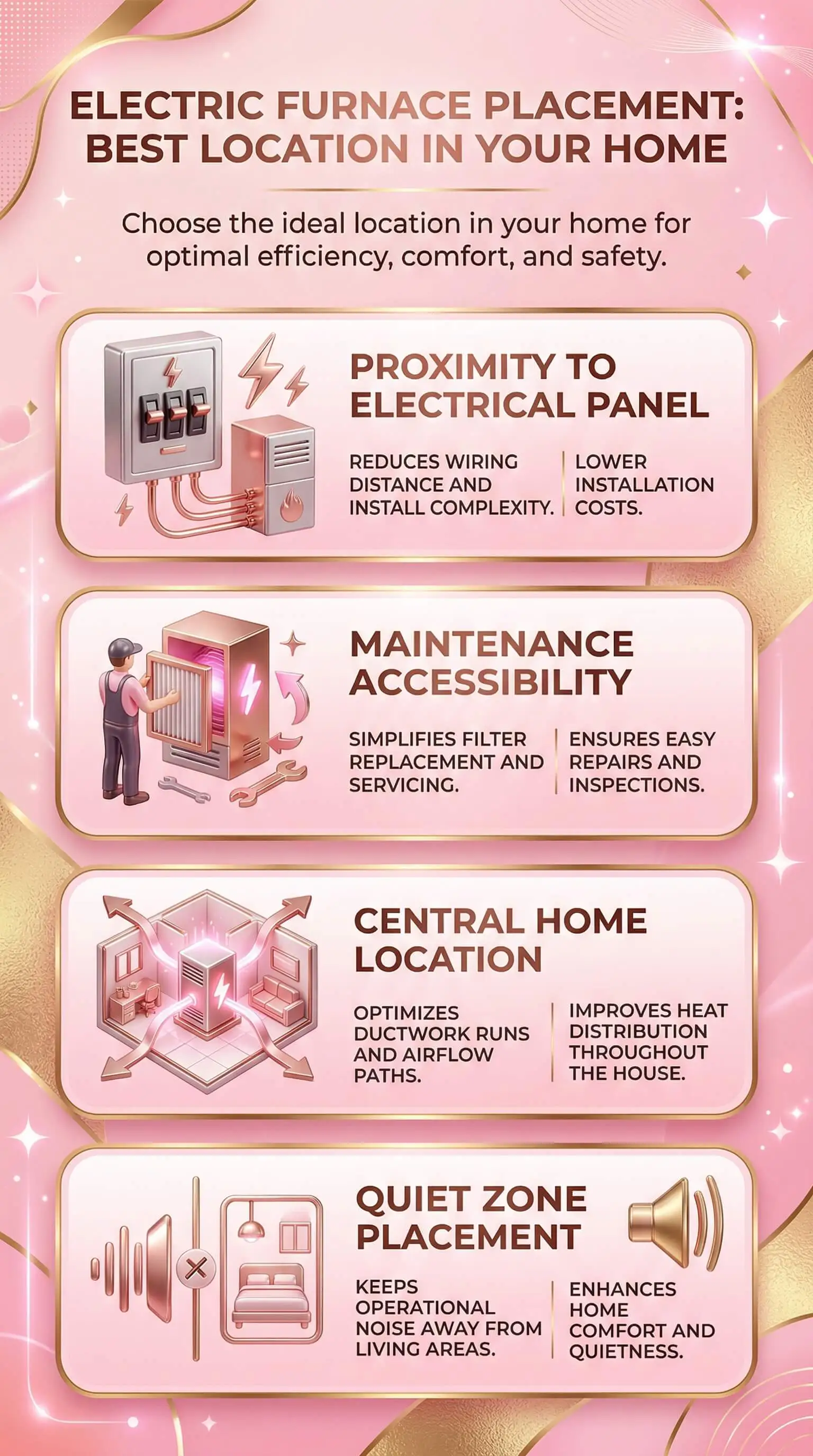
Best placement: Inside conditioned space, close to the home's central return air pathway, with a minimum 30 inches of front clearance for service and filter access
Filter role: The return air filter protects the blower and captures airborne particles every time the system runs — placement determines how evenly it draws air across the home and how effectively it filters every room
Maintenance: Check the filter monthly — replace every one to three months based on dust levels, pets, and system runtime
Common mistake: Installing in an undersized closet or unconditioned space without adequate insulation — both reduce efficiency and shorten equipment life from day one
After manufacturing air filters for over a decade and serving over two million households, the single most overlooked fact about electric furnaces is this: the unit's rated performance and its real-world performance are only equal when placement, airflow, and filter maintenance are all working together.
Top Takeaways
Placement is a performance decision, not just a logistical one. Where your furnace sits determines how efficiently it heats, how evenly it filters, and what it costs to run — every season, for the life of the system. The homes that struggle most with uneven heating and premature filter replacement are rarely dealing with a bad furnace. They're dealing with a furnace placed without considering how air moves through the home.
Poor placement compounds silently over time. The efficiency gap rarely shows up in a single utility bill. It builds across heating seasons — filters loading faster, energy costs climbing, rooms staying just short of comfortable. None of it traces back to the furnace itself.
Duct placement and insulation are where placement decisions become energy losses. Every uninsulated duct run through an attic, crawl space, or garage is energy your system generates but your rooms never receive. Government research confirms duct leakage and poor insulation alone can eliminate a third of a system's effective capacity — from the moment it turns on.
Placement directly affects your air filter — and most homeowners never make that connection. A furnace that draws unevenly doesn't just heat unevenly. It filters unevenly. Rooms farther from the return get less circulation. Contaminants concentrate where the system reaches least. Filters wear out in patterns that don't match their rated lifespan. After serving over two million households, this is one of the most consistent — and overlooked — consequences of poor placement we've encountered.
The right placement checklist must happen before installation — not after. Follow these steps before the unit goes in:
Ask where the furnace should go before deciding which furnace to buy.
Confirm clearance requirements meet manufacturer specifications.
Verify filter access is unobstructed before installation is complete.
Keep duct runs within conditioned space wherever possible.
How Electric Furnace Placement Affects System Performance
Placement isn't just a logistical decision — it's a performance decision. An electric furnace installed too far from the home's central return air pathway has to work harder to pull in enough air to heat efficiently. That extra strain shows up on your energy bill and in your filter, which loads up faster when airflow is restricted or unbalanced.
In our experience serving over two million households, the homes that struggle most with uneven heating and furnace filter replacement are rarely dealing with a bad furnace. More often, they're dealing with a furnace that was placed without considering how air moves through the home.
The Best Locations for an Electric Furnace
Not every home offers the same options, but some locations consistently outperform others. Here's how the most common placement choices compare:
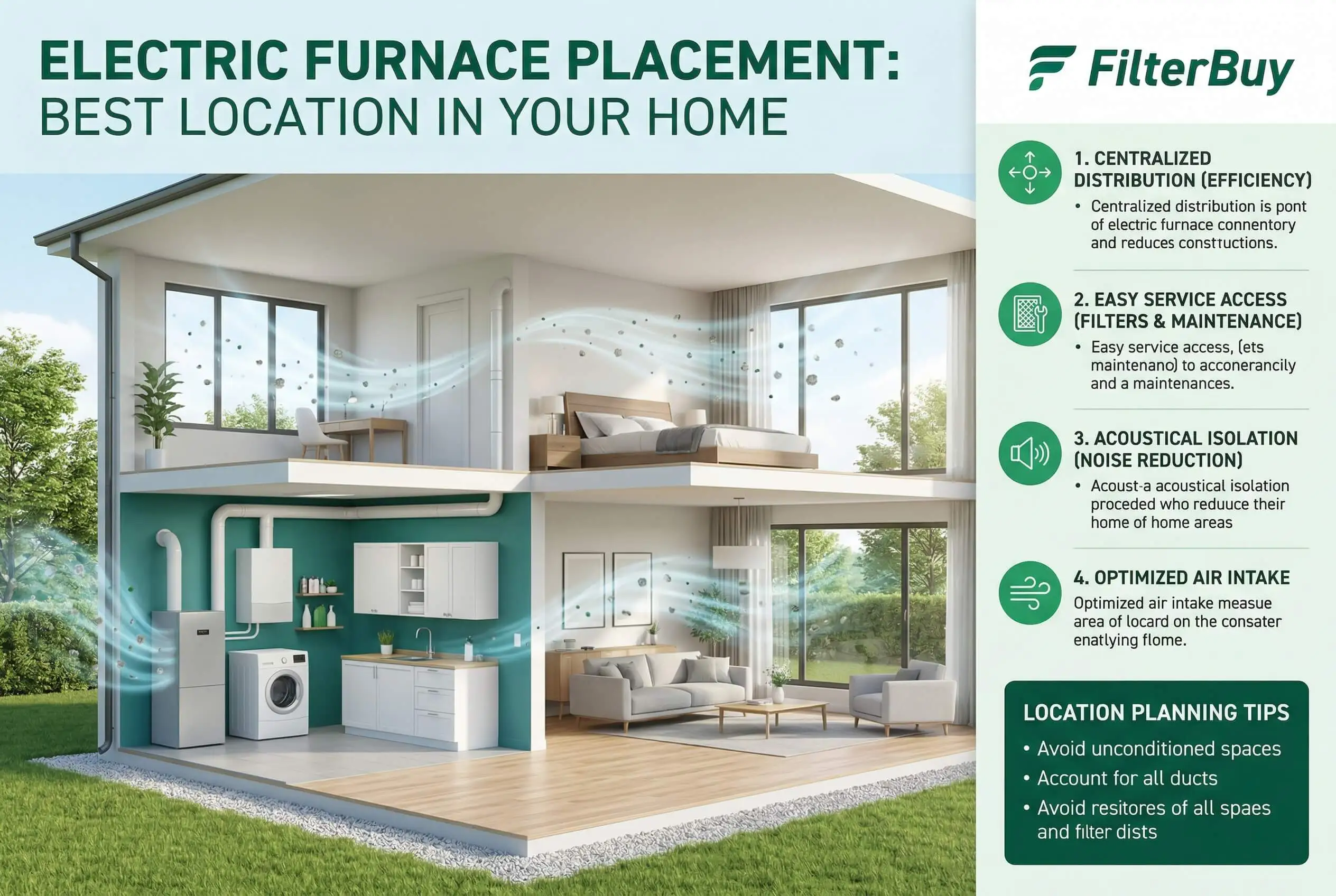
Basement: The most reliable location in homes that have one. Basements offer stable temperatures, easy access for maintenance, and natural proximity to return air pathways. Heat rises naturally from a basement installation, supporting even distribution across living spaces.
Interior utility closet: A practical option in homes without a basement. The closet must be properly sized — undersized closets restrict airflow and trap heat around the unit, which shortens equipment life. Doors should be louvered or vented to allow adequate air exchange.
Attic: Works in climates where attic temperatures don't swing to extremes. The primary concern is ductwork insulation — uninsulated ducts in a hot attic bleed heat before it reaches living spaces, reducing efficiency significantly.
Garage: Acceptable in mild climates when conditioned space is unavailable, but the temperature swings in an unconditioned garage can reduce efficiency and stress electrical components over time. Proper insulation around the unit is essential.
Crawl space: The least ideal option. Limited access makes maintenance harder, and moisture exposure can affect electrical components and accelerate filter degradation. If a crawl space is the only option, a sealed, encapsulated crawl space is strongly preferred.
Clearance Requirements That Protect Your Equipment
Every electric furnace installation requires minimum clearances — the manufacturer-specified distances between the unit and surrounding walls, ceilings, and combustibles. Violating these clearances doesn't just void warranties. It restricts the airflow the system needs to operate safely and efficiently.
Standard clearance guidelines to follow:
Maintain at least 30 inches of front clearance for service access
Follow manufacturer specifications for side and rear clearance — typically 1 to 6 inches depending on the unit
Never block return air pathways with storage, shelving, or furniture placed near the air handler
Ensure the filter access panel can be fully opened without obstruction — a filter you can't easily reach is a filter that won't get changed on schedule
How Placement Affects Your Air Filter
This is something most installation guides don't address — and something we're in a unique position to speak to. Where your furnace is located directly affects how quickly your air filter loads with particulates and how evenly it captures contaminants from across the home.
A furnace placed near the home's central return creates a more balanced draw across all rooms, which means the filter captures contaminants more evenly and lasts closer to its rated lifespan. A furnace tucked at the far end of a long duct run creates an uneven draw — some rooms get filtered air less frequently, and the filter itself may load unevenly, reducing its effective capture area before it technically needs replacement.
Placement Mistakes That Shorten System Life
Based on what we see across millions of household HVAC configurations, these are the placement errors that cause the most long-term problems:
Placing the furnace in an unconditioned space without proper insulation around ductwork
Installing in a closet too small to meet manufacturer clearance specifications
Locating the unit far from the home's primary return air chase, forcing long, inefficient duct runs
Failing to account for filter access during installation — units wedged into tight corners often go months without filter changes simply because access is too difficult
Ignoring local code requirements, which vary by municipality and can affect both permit approval and homeowner's insurance coverage
"Most homeowners focus on the furnace itself — the brand, the efficiency rating, the warranty — and that's understandable. But in our experience working with over two million households, placement is the variable that determines whether a well-spec'd system actually performs the way it should. We've seen high-quality electric furnaces underdeliver for years simply because they were installed in the wrong location — too far from the central return, cramped into an undersized closet, or tucked into an unconditioned space with no insulation around the ductwork. What surprises most people is how directly placement affects the air filter. A furnace that draws unevenly across the home doesn't just heat unevenly — it filters unevenly. Rooms farther from the return get less air circulation, contaminants concentrate in areas the filter never fully reaches, and the filter itself wears out in ways that don't match its rated lifespan. Placement isn't a footnote to the installation — it's the foundation of everything that comes after it."
Essential Resources
Placement is only one part of the decision. Where your furnace sits affects how it heats, how it filters, and what it costs to run. These seven government and EPA-sourced resources give you the full picture — from how electric furnaces work to what efficiency standards actually mean for your home.
1. Understand How Electric Furnaces Actually Move Heat Through Your Home Your furnace heats air with electric elements and pushes it through ducts with a blower. The DOE's electric resistance heating guide explains how that process works — and why where those ducts run determines how much heat actually reaches your rooms. https://www.energy.gov/energysaver/electric-resistance-heating
2. Learn What Furnace Sizing and Efficiency Ratings Mean for Your Installation Bigger is not always better. The DOE's furnaces and boilers resource explains how sizing and efficiency ratings interact — and why an oversized or poorly placed furnace works harder, costs more, and wears out faster. https://www.energy.gov/energysaver/furnaces-and-boilers
3. See Why Placement and Installation Quality Are Federal Efficiency Standards The federal government's furnace purchasing guidance is direct: improper installation — poor placement, oversizing, leaky ducts — causes efficiency losses and shorter equipment life. This resource explains what a proper installation actually requires. https://www.energy.gov/femp/purchasing-energy-efficient-residential-furnaces
4. Compare ENERGY STAR Certified Furnaces Before You Buy Not all furnaces are certified equal. The EPA's official ENERGY STAR furnace directory lists certified products by efficiency level and blower motor type — a verified starting point before you commit to a unit and a location. https://www.energystar.gov/products/furnaces
5. Discover How Your Furnace's Location Affects the Air Your Family Breathes Where your furnace and air handler sit determines how evenly air moves through your home — and how effectively your filter captures what is floating in it. The EPA's HVAC and indoor air quality resource covers the connection between equipment placement, duct routing, and MERV filter selection. https://www.epa.gov/iaq-schools/heating-ventilation-and-air-conditioning-systems-part-indoor-air-quality-design-tools
6. Find Out What the EPA Says About Duct Maintenance After Installation A furnace placed far from the central return creates longer duct runs — and longer duct runs collect more dust. This EPA consumer guide explains what to do about duct contamination and how to prevent it from affecting your air quality and filter performance over time. https://www.epa.gov/indoor-air-quality-iaq/should-you-have-air-ducts-your-home-cleaned
7. Get the Full Picture on Heating Efficiency and Long-Term Equipment Care AFUE, HSPF, COP — this ENERGY STAR heating and cooling guide explains what each metric means in plain terms. It also covers equipment life expectancy and the maintenance habits that protect your system once it is in the right place. https://www.energystar.gov/sites/default/files/asset/document/HeatingCoolingGuide%20FINAL_9-4-09_0.pdf
Supporting Statistics
Most homeowners focus on the furnace itself — size, brand, price. The data tells a different story. Where your furnace sits, how its ducts run, and how evenly it draws air across your home shape your energy costs and your indoor air quality for the life of the system. Here is what the research shows — and what we've seen firsthand across over two million households.
Indoor Pollutant Concentrations Are Often 2 to 5 Times Higher Inside Your Home Than Outside
Americans spend approximately 90 percent of their time indoors, where the concentrations of some pollutants are often 2 to 5 times higher than typical outdoor concentrations. US EPA
That number surprises most people. It shouldn't. Here's why placement makes it worse:
Homes are sealed environments. Without balanced airflow, pollutants accumulate instead of clearing.
A furnace placed far from the central return creates an uneven draw across living spaces.
Rooms at the end of that draw get less air circulation — and less filtration — every time the system runs.
We've seen this repeat across household configurations in every climate region we serve.
The filter does its job where the air reaches it. Placement determines where that is.
Source: U.S. Environmental Protection Agency — https://www.epa.gov/report-environment/indoor-air-quality
Space Heating Is the Single Largest Energy End Use in American Homes — at 42% of Total Residential Consumption
Space heating continued to be the top energy-consuming end use in U.S. homes in 2020, accounting for 42% of energy consumption in the residential sector. U.S. Energy Information Administration
Nearly half of every energy dollar spent at home goes toward heating. That makes furnace placement one of the highest-leverage decisions a homeowner will make — and rarely think twice about.
What the efficiency gap from poor placement looks like in practice:
It rarely shows up in a single month's utility bill.
It compounds quietly, across heating seasons.
The system works incrementally harder than it should — compensating for a problem locked in on installation day.
In our experience, most homeowners don't connect rising energy costs to a placement decision made years earlier.
Source: U.S. Energy Information Administration — https://www.eia.gov/pressroom/releases/press535.php
In Single-Family Homes, Space Heating Accounts for 46% of Total Household Energy Consumption
In single-family detached homes, space heating was by far the largest end use at 46% of total consumption. U.S. Energy Information Administration
Single-family homes represent the majority of households we serve — and the homes where placement decisions carry the most weight, especially for heat pump performance. Unlike apartments, single-family homes expose more of their duct system to unconditioned spaces.
The compounding risks in single-family installations:
Attics, crawl spaces, and garages are common duct pathways — and common sources of heat loss.
Every uninsulated foot of duct run through those spaces is energy generated but never delivered.
That loss doesn't appear on a spec sheet. It appears in the gap between rated performance and real-world output.
We've been helping homeowners close that gap for over a decade.
Source: U.S. Energy Information Administration — https://www.eia.gov/todayinenergy/detail.php?id=37433
Final Thoughts
Electric furnace placement doesn't make headlines. It doesn't come with an efficiency rating you can compare on a spec sheet. But in our experience working with over two million households, few installation decisions have a longer reach — or a quieter cost when they go wrong.
Here is what most installation guides won't tell you:
Placement isn't a one-time structural decision. It repeats itself every heating cycle.
Every filter load and every energy bill is shaped by where that furnace sits and how well the air around it moves.
Get it right and the system delivers what it was rated to deliver.
Get it wrong and you spend years compensating — with higher bills, faster filter turnover, and rooms that never reach the thermostat temperature.
What We See After Installation
Our perspective is shaped by something most HVAC resources can't draw on: a direct view into what happens after the unit goes in. We see it in filter loading patterns across millions of households. The warning signs are consistent:
Filters load twice as fast as they should.
Homeowners upgrading to higher MERV ratings expecting cleaner air — only to find the real problem is inadequate airflow, not inadequate filtration.
Half a home received less circulation than the other half, simply because of where the furnace was placed.
Placement isn't a filtration problem. But poor placement makes every filtration problem harder to solve.
What the Homeowners Who Get This Right Have in Common
They don't treat placement as a constraint to work around. They treat it as a specification to meet. Specifically:
They ask where the furnace should go before they ask which furnace to buy.
They think about filter access before the unit goes in — not after.
They understand that the right furnace, in the right location, connected to a well-designed duct system, with a properly rated filter maintained on schedule, is one of the most effective investments a family can make in the air inside their home.
FAQ on Electric Furnace
Q: What is the best location to place an electric furnace in my home?
A: The best location puts your furnace close to the home's central return air pathway, inside conditioned space, with clear access for service and filter changes.
Best locations ranked by performance:
Basement — stable temperatures, natural proximity to return air, easy maintenance access
Interior utility closet — reliable when properly sized and vented
Conditioned attic — viable in mild climates with insulated ductwork
Garage or crawl space — last resort only, with proper insulation and code compliance
What most placement guides don't mention: location determines how evenly your filter captures contaminants across the home. A furnace placed far from the central return draws unevenly. Rooms it draws from least get the least filtration. After working with over two million households, we see this connection between placement and filter performance play out every day — and it rarely gets addressed until the problem is years in the making.
Q: How much clearance does an electric furnace need?
A: Always follow the manufacturer's specification. These standards apply in most installations:
Front: At least 30 inches for service and filter access
Sides and rear: Typically 1 to 6 inches depending on the unit
Filter access panel: Must open fully without obstruction
Clearance isn't a formality. Without adequate clearance:
The furnace can't breathe properly
The filter loads unevenly
The system wears faster than its rated lifespan
The costliest clearance mistake we've seen isn't a code violation. It's a filter access panel that can't fully open — meaning the filter doesn't get changed, and the system runs dirty for months without the homeowner realizing it.
Q: Can an electric furnace be installed in a garage?
A: Yes — but the trade-offs are real.
What most homeowners don't see coming:
Garages are unconditioned spaces in most climates
Temperature swings stress electrical components over time
Uninsulated duct runs bleed heat before it reaches living spaces
Heat loss compounds across every heating season — not as a single spike, but as a steady, invisible drain on operating costs
If a garage is the only viable option:
Insulate the furnace and surrounding ductwork thoroughly
Confirm the installation meets local code for equipment in attached garage spaces
Budget for higher operating costs relative to a conditioned space installation
Going in without addressing both insulation and code compliance typically costs more in the long run than the installation saved upfront.
Q: Does electric furnace placement affect indoor air quality?
A: More than most homeowners realize. The EPA confirms indoor pollutant concentrations already run 2 to 5 times higher than outdoor levels in the average home. Poor placement makes it worse.
Here is what uneven furnace placement looks like in practice:
Rooms farther from the return get less circulation every time the system runs
Less circulation means less filtration in those rooms
Contaminants concentrate where the system reaches least
We see this show up in a consistent pattern across the households we serve:
Filters wearing unevenly
Filters loading faster than their rated lifespan
Heavy particulate buildup on one side of the filter, light buildup on the other
That is not a filter problem. That is a placement problem the filter is absorbing. The right filter helps — but it can't compensate for a furnace that isn't drawing balanced airflow across your home to begin with.
Q: Can I install an electric furnace in a small utility closet?
A: Yes — if the closet meets three requirements without compromise:
Adequate sizing — enough room for the unit plus all manufacturer-specified clearances on every side
Proper ventilation — louvered or vented doors to allow adequate air exchange around the unit
Unobstructed filter access — the filter panel must open fully without moving the unit or clearing surrounding materials
The most common closet installation mistakes we see:
Undersizing the space to fit the unit plus required clearances
Using solid doors that restrict air exchange around the unit
Positioning the unit so the filter panel can't fully open
The most costly mistake: inaccessible filter access. A filter you can't easily reach won't get changed on schedule. A filter that doesn't get changed means:
The blower works against increasing resistance every cycle
Airflow drops across the system
Equipment life shortens
Air quality degrades — quietly, over months
If the closet can't meet all three requirements, it isn't the right location — regardless of how convenient it looks on installation day.
Ready to Get Electric Furnace Placement Right From Day One?
Getting placement right protects your system, your energy costs, and the air your family breathes — and it starts with making sure the right filter is in the right furnace from day one. Shop Filterbuy's American-made air filters, find your exact size, and set up a delivery schedule so filter maintenance never becomes the problem that placement has already solved.